
Share the page
ECOPRONAT – Research to promote the development of a pro-nature economy

In a context of accelerated biodiversity loss, the research program for a pro-nature economy (ECOPRONAT) supported research on how to improve the integration of biodiversity in key economic sectors.
Context & objectives
In addition to taking actions that protect ecosystems and endangered species, there is an urgent need to implement transformative changes in economic sectors that cause environmental degradation. This is the conclusion of the 2019 Global Assessment Report on Biodiversity and Ecosystem Services, by the Intergovernmental Science-Policy Platform on Biodiversity and Ecosystem Services (IPBES). “Nature is globally declining at an unprecedented rate in human history – and the rate of species extinction is accelerating,” the report confirms, noting that communities suffer from the loss of the very ecosystem benefits on which they depend.
Current global responses are insufficient, the IPBES states, but through urgent and concerted efforts, it is possible to conserve, restore and use nature sustainably while also achieving other societal goals.
Following this logic, AFD Group’s ECOPRONAT research program (2020-2024) promoted the development of a pro-nature economy based on research findings. It aimed to:
- Develop knowledge and methodologies to mainstream biodiversity in public policy and AFD Group activities, from agriculture to spatial planning and sustainable cities
- Mobilize financial resources to bring about transformative change
- Build the capacity of researchers across the Global South
- Provide support for change management to AFD’s partners
ECOPRONAT was structured around research activities and capacity building actions, particularly for local researchers in our partner countries and those involved in pro-nature projects. It is part of AFD's research program on ecological transitions.
At the end of the programme in late 2025, the external evaluation firm Quadrant Conseil conducted an independent evaluation of the ECOPRONAT programme’s impacts. The evaluation confirmed the originality of the knowledge generated, its systematic dissemination to both scientific and non-specialist audiences, and the tangible influence of several research projects on public policies in the countries and territories where they were implemented.
Find out more

Component 1: Research activities
ECOPRONAT aimed at developing knowledge and methodologies to mainstream biodiversity into public policies and into several areas of activity of AFD Group. ECOPRONAT also supported initiatives to mobilize the financial resources needed to effect these changes.
The first ECOPRONAT call for projects focused on mainstreaming biodiversity in three sectors – agriculture, regional planning and urban development – and on its financing.
Two projects were selected:
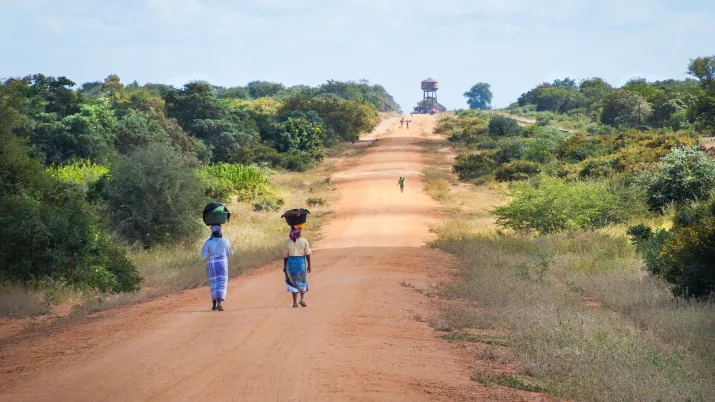
- One identifies agricultural systems contributing to food security, poverty alleviation and biodiversity in Mozambique
- The other studies wildlife economies to find ways to incorporate biodiversity in agricultural policies in South Africa and Kenya
Four projects were selected under the second ECOPRONAT call for projects, which focused on scaling up nature-based solutions and large-scale ecological restoration. The projects:
- Enable the scaling up of nature-based solutions in Latin American Cities (ENSLAC)
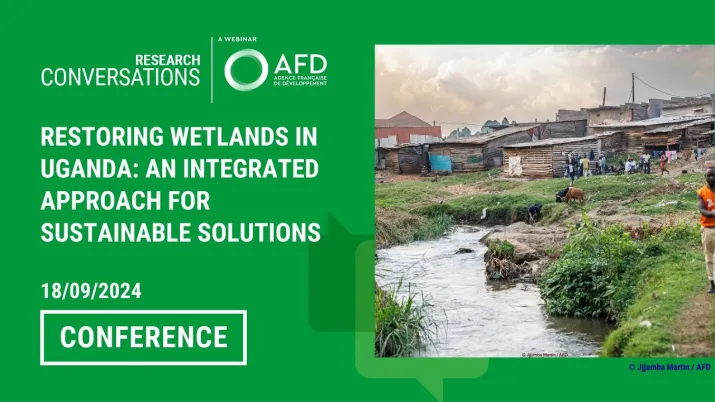
- Address constraints to upscaling sustainable wetland restoration and management in Uganda
- Help green urban food systems through nature-based solutions in Bengaluru, India
- Develop a strategic framework for city-wide nature-based solutions, based on cases in Rwanda and Ethiopia
The ESGAP (Environmental Sustainability Gap) is a strong sustainability indicator that makes it possible to assess the environmental sustainability of a given country, region or locality. This can help establish international standards governing ecosystems and their ecological status.
The ECOPRONAT program supports research dedicated to the development of the strong sustainability indicator, and has supported case studies in Vietnam and Kenya. Following a call for projects, two more studies are underway:
- A first study aims to develop indicators for biodiversity and the health of natural ecosystems, as well as an ESGAP methodology in South Africa and Colombia.
- A second study aims to refine socio-economic indicators and study the relationship between the economy and the environment, with Vietnam as a case study.
The program also supported contributions to the United Nations Environment Program (UNEP) report, Measuring Progress: Environment and the SDGs (2021).
- Support for the implementation of the TNFD
The ECOPRONAT program supports the mainstreaming of biodiversity in the financial sector by supporting the implementation of the Taskforce on Nature-related financial Disclosures (TNFD), an international initiative in which AFD is involved. The objective of the taskforce is to develop a common framework for financial institutions and businesses to assess, monitor and publish financial risks related to biodiversity decline.
The ECOPRONAT program supported a study on the level of preparedness of public development banks for the use of risk management and disclosure frameworks produced by this initiative. This research highlighted the expertise of public development banks in mitigating environmental risks in their investments and identified levers and opportunities for collaboration with the TNFD.
- Research on metrics of impact and dependence of economic activities on biodiversity
Many metrics are being developed at the international level to help businesses and financial institutions assess and reduce their biodiversity footprint. The ECOPRONAT program supports the implementation of a comparison test between the six most advanced metrics, to assess their relevance for development projects and to better characterize the environmental impacts of the latter.
The study on the design of this comparative analysis, conducted by The Biodiversity Consultancy, is available online. The research project on biodiversity metrics for Public Development Banks (PDBs) is conducted by the Biotope/Arcadis consortium.
Watch our research webinars
- A strategic framework for nature-based solutions in urban areas: learning from Addis Ababa and Kigali's experience
- What levers for the deployment of nature-based solutions in South America?
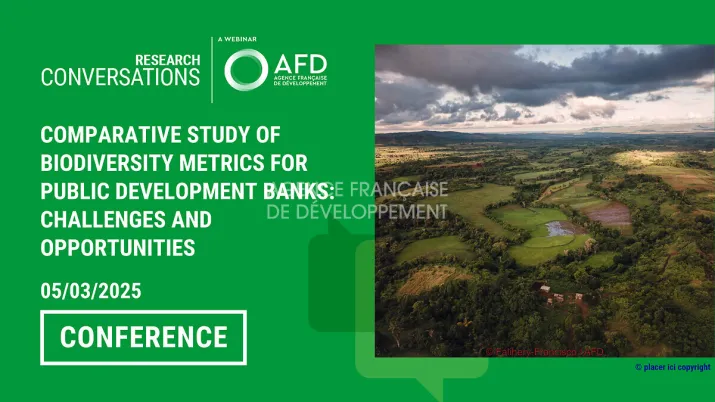
- Comparative study of biodiversity metrics for Public Development Banks: Challenges and opportunities
- Measuring environmental sustainability of a country : application of the ESGAP framework in Colombia and South Africa
- Restoring wetlands in Uganda: an integrated approach for sustainable solutions
- Identifying farming systems that contribute to food security, the fight against poverty and biodiversity: challenges and possible solutions
Component 2: Capacity-building
Beyond research funding, ECOPRONAT supported and accompanied local researchers in partner countries and pro-nature project leaders working on biodiversity issues.
In early 2021, AFD and the AFD and the Global Development Network (GDN) lauched their joint "Biodiversity and Development" award to support researchers working to preserve biodiversity.
This award programme targeted researchers based in low and middle-income countries. It aimed to identify and support productive multidisciplinary engagements on biodiversity mainstreaming, including multi-country projects, and to boost the availability and use of quality evidence in public debates and corporate practices.
The programme supported five research teams working in Africa, Asia, Latin America and the Pacific through a structured combination of funding, tailored mentoring, and ongoing technical support. Each team received guidance from scientific and policy mentors, participated in cross-team and cross-country exchanges, and contributed to joint learning activities coordinated by GDN.
Throughout the programme, GDN facilitated regular check-ins, capacity-building sessions, and collaborative spaces to strengthen methodological quality, improve communication strategies, and support multi, inter, and transdisciplinary research.
Read also: AFD-GDN Biodiversity and Development Award: the winners and their projects
More testimonies are available on YouTube.
Since 2021, AFD Campus organized three rounds of support for pro-nature initiatives in Southern Africa as part of the Biodiversity Partnership Program (BiPP), in partnership with the Sustainability Institute. It has supported 25 pro-nature project leaders in fields as varied as tapping into local knowledge, nature-based solutions, business management, deep ecology, systemic thinking, and graphic design.
Discovering the Biodiversity Partners Programme
A new cycle called NABTA (Nature, Biodiversity and Transitions in North Africa) was launched in 2023, in collaboration with INCO.
Governance
A steering committee meets twice a year to discuss and arbitrate the orientations of the research program, as well as to carry out the scientific monitoring of funded research activities.
This steering committee is composed of representatives of the French Ministry for Europe and Foreign Affairs and the French Ministry of Ecological Transition; AFD Group’s relevant departments; the French Global Environment Facility (FFEM); and various other partners mobilized for their expertise in the issues addressed.
Associated research projects


Webinar replays
Contact
-
Julien CALAS
Research Officer on Biodiversity